
Why Your Best Video Content Might Be Failing Your Mission
Most nonprofits measure the wrong thing. Here's what to measure instead.
There's a moment that happens in nearly every mission-driven organization I've worked with. A video goes up. Views climb. The comments are warm. Someone shares it with the caption "this moved me." Leadership celebrates. The communications team exhales.
And then, nothing changes. The behavior you actually needed to shift stays exactly where it was.
This is the gap. And almost no one is talking about it.
After nearly 20 years of working in storytelling across mission-driven sectors, from documentary work at the Wilson Center and National Geographic to production partnerships with the American Hospital Association, American Kidney Fund, and Smithsonian, I've watched this pattern repeat with remarkable consistency. What's striking is that most organizations caught in it don't realize it's happening. The metrics they're watching look fine. The content feels successful. But the mission outcomes it was supposed to advance remain unchanged.
The problem isn't that your video is bad. The problem is that you're measuring the wrong thing.
The Vanity Metric Trap
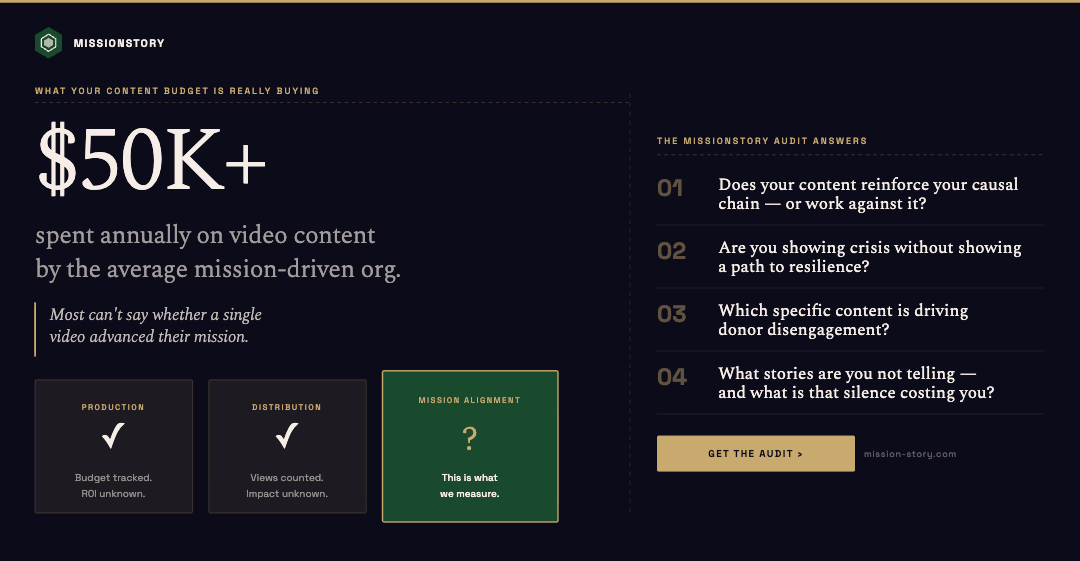
The nonprofit content world has quietly adopted the wrong scorecard. We've borrowed our success metrics from the entertainment industry – views, likes, shares, watch time – and applied them to work that has an entirely different goal. Entertainment wants attention. Mission-driven content needs to move people to act, give, believe, change.
Those are not the same thing.
A video can be genuinely beautiful, emotionally resonant, and technically flawless and still fail at advancing your theory of change. It can go viral among people who will never donate. It can generate thousands of comments from audiences who feel sympathy but not efficacy. It can win awards while your program outcomes stagnate.
Here's the trap: engagement metrics feel good. They're easy to measure. They tell a story of success that's hard to argue with. So we keep using them. We optimize for them. We build content strategies around them. And no one stops to ask whether they're connected to what actually matters.
High engagement does not equal high impact.
The logic that got us here makes sense. Social media algorithms reward engagement. Digital advertising is built on click metrics. The entertainment industry proved that attention is valuable. So when nonprofits needed a way to measure content success, these frameworks were already there, proven, and easy to implement. We didn't invent the vanity metric trap – we inherited it.
But inheritance doesn't make it right for mission-driven work.
The core problem is this: emotion is necessary but not sufficient. A video that moves people emotionally doesn't automatically move them to action. In fact, there's a well-documented psychological pattern that happens when audiences encounter a crisis without agency, a problem without a solution. Fear without efficacy produces avoidance, not activation. People don't mobilize in response to helplessness. They disengage. They scroll past. They feel bad and redirect their attention to something that doesn't make them feel that way.
This is why a beautifully produced documentary about a massive social problem can rack up millions of views and fail to shift a single policy, mobilize a single volunteer base, or change a single person's understanding of what's possible.
What a Theory of Change Actually Demands
Every serious organization has a theory of change – even if it's not written down. It's the causal logic that connects what you do to the difference you make. Inputs flow into activities. Activities produce outputs. Outputs generate outcomes. Outcomes accumulate into impact.
Your content should be doing the same work.
If your theory of change depends on shifting public perception about a specific issue, your content needs to carry people from one mental model to another. If it depends on mobilizing existing supporters into action, your content needs to create clear behavioral pathways. If it depends on converting first-time donors into long-term investors in your mission, your content needs to build trust, demonstrate competence, and show them what sustained change actually looks like.
Most organizational content does none of these things precisely. It evokes emotion, which is necessary but not sufficient. It shows the problem, which creates awareness but not movement. It features the organization, which builds a brand but not a belief.
The gap between "our content is good" and "our content is advancing our theory of change" is where most nonprofits are operating without realizing it.
Consider this: You can have a theory of change that reads "If we help people understand the efficacy of early intervention, then parents will seek services earlier, resulting in better long-term outcomes." But if your content only shows the problem (kids struggling without intervention) and never shows what early intervention looks like in practice, what agency families have, what the pathway to change actually feels like – then your content is working against your theory of change, not for it.
The question isn't whether your content is good. The question is whether it's doing the right job.
The Narrative Negative Space Problem
One of the most damaging patterns I encounter in organizational content audits is what I call Narrative Negative Space – the critical stories an organization isn't telling, and the psychological effect that absence creates.
Behavioral science is clear on this: fear without efficacy produces avoidance, not action.
When audiences are shown crisis after crisis—the burning forest, the displaced family, the shrinking glacier—without an equally compelling narrative of resilience, agency, and solvable problems, they don't mobilize. They disengage. They scroll past. They feel helpless and redirect their attention to something that doesn't make them feel paralyzed.
This is one of the most common gaps I find in organizational content audits. Organizations so committed to communicating the urgency of their mission that they've inadvertently built a content ecosystem that makes their audience feel paralyzed rather than empowered.
I worked with a health advocacy organization that was generating significant viewership for its content about disease burden and patient struggles. The metrics looked excellent. But when we audited their content against their actual theory of change – which centered on mobilizing patients into self-advocacy and treatment adherence – we found that nearly 80% of their narrative focus was on the problem, not on what agency, recovery, or change looked like. Patients were portrayed primarily as victims of circumstance, not agents of their own care. The unintended message: "Your situation is dire, and you can't change it." That's the opposite of mobilization.
The fix isn't to minimize the problem. It's to ensure that your protagonists – the people at the center of your stories—are agents, not victims. That your content shows what change looks like in motion, not just what absence of change feels like. That crisis and resilience exist in proportion.
When you tell the story of a crisis without showing agency, solvability, or pathways to change, you're inadvertently training your audience to feel helpless. And helpless audiences don't act.
Introducing the Impact Gap Analysis
This gap between what you're measuring and what you need to measure was the reason I developed the Impact Gap Analysis—a proprietary audit of an organization's video storytelling strategy, measured directly against its own stated theory of change.
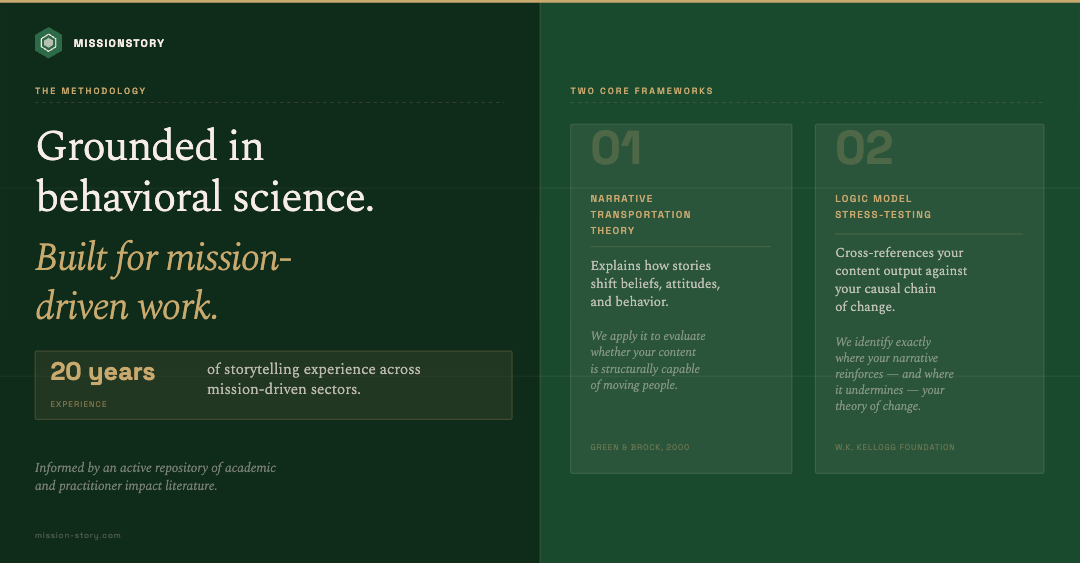
The Impact Gap Analysis draws on two evidence-based frameworks: Narrative Transportation Theory, which explains how stories actually shift beliefs and behaviors, and Logic Model Stress-Testing, which cross-references your actual content output against your causal chain of change.
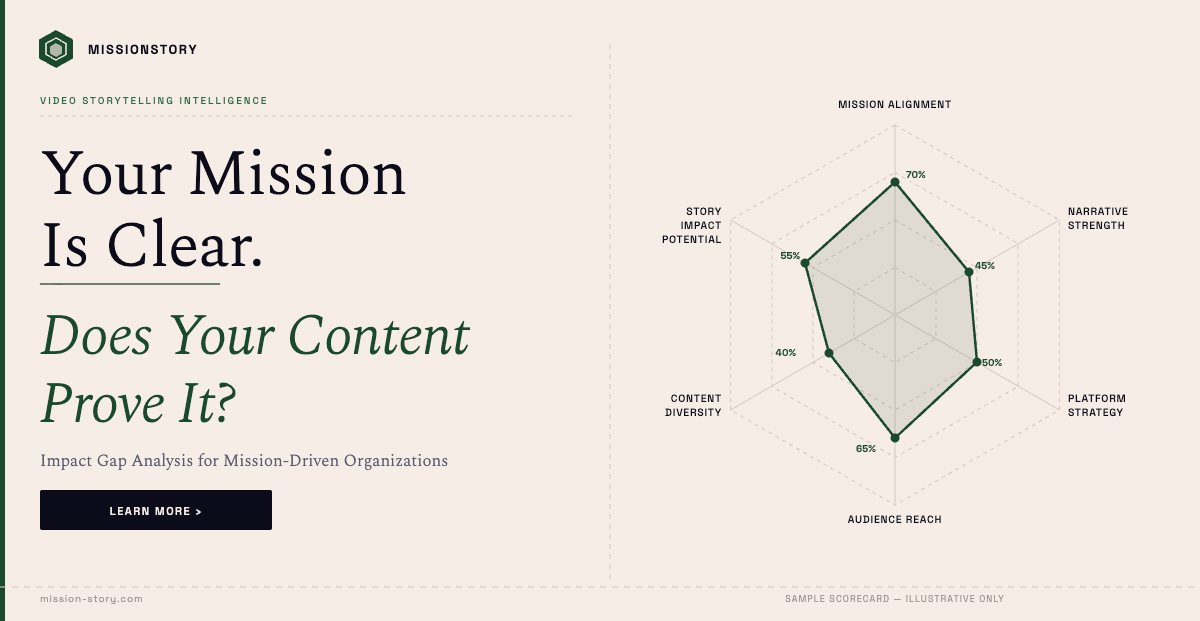
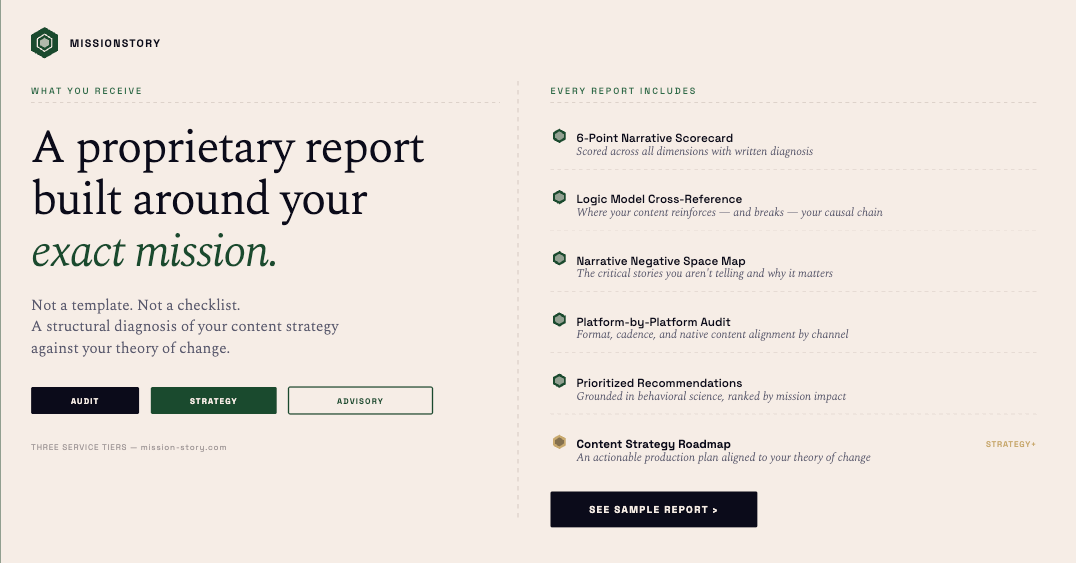
The result is what I call a 6-Point Narrative Scorecard that evaluates your content across six dimensions:
Mission Alignment — Does your content actually advance your goal, or does it generate noise around it? These are different things. A beautiful story about the problem is not the same as a strategic story about change.
Narrative Strength — Are there clear protagonists with emotional arcs? Does your audience have someone to follow through the story? Or are your characters secondary to the message?
Platform Strategy — Is your content native to the medium it lives on? A vertical video designed for TikTok performs differently than the same video repurposed into a landscape YouTube upload. Format is not neutral. Platform is not neutral.
Audience Reach — Is your growth trajectory healthy and sustainable, or are you reaching the same people repeatedly while missing the audiences your mission requires? Are you preaching to the converted or reaching new constituencies?
Content Diversity — Are you over-relying on a single format or emotional register? Organizational content that only ever tells one kind of story creates predictability—and predictability is the enemy of attention and engagement.
Story Impact Potential — Does your content model the behavior change you need? Does it show people what it looks like to act, to give, to engage—not just why they should? Or does it stop at awareness?
Each dimension is scored and analyzed against your specific organizational context. The audit doesn't produce generic recommendations. It produces a precise map of where your content investment is reinforcing your mission and where it's inadvertently working against it.
The insight is simple: Alignment doesn't happen by accident. It happens by design.
Nearly Two Decades. One Clear Finding.
I've spent close to 20 years studying how stories move people – through documentary work, content strategy, organizational communication, and a deep engagement with the academic literature on narrative persuasion and behavioral change. That body of work has produced one consistent finding:
The organizations that change minds and mobilize action aren't the ones with the biggest budgets or the most sophisticated production. They're the ones whose stories are structurally aligned with what they're actually trying to accomplish.
When I audit a nonprofit's content strategy, I'm not looking for production quality. I'm looking for coherence. Do the stories they're telling actually serve the change they're trying to make? Is there a causal logic connecting content strategy to mission outcomes? Or are they optimizing for metrics that feel good but don't move the needle?
The gap between good content and aligned content is where most mission-driven organizations are operating. And it's also where the most significant opportunity exists.
If you're producing video content and you're not certain it's advancing your theory of change, the Impact Gap Analysis was built for you.
Your mission is clear. Make sure your content proves it.
MissionStory offers Impact Gap Analysis audits at three service tiers, from foundational reports to full strategic advisory engagements. Learn more at mission-story.com.